
1. Preamble
The Social Security Financing Law for 2026 (LFSS 2026) has been definitively adopted. In addition, several decrees will be issued to specify its implementing provisions. This summary note provides an overview of the main measures.
2. The main measures of the LFSS 2026
2.1 Replacement DSN
- Principle:
The URSSAF carries out a monthly analysis of the Nominative Social Declarations (DSN in French) in order to make the data declared by companies more reliable.
- Anomaly management
If an anomaly is detected, a Business Report (CRM in French) is sent to the employer to enable correction of the declaration. Two types of CRM may be issued:
- a monthly CRM, transmitted when an anomaly is identified;
- an annual CRM, summarizing the uncorrected anomalies for year N-1.
The employer has a period of two months to correct the DSN or, if necessary, to contest the anomaly reported.
- In the absence of correction
If no regularisation is made within the prescribed timeframe, URSSAF may make the corrections itself by issuing a replacement DSN.
- Consequences
2.2 Contractual termination and retirement
The specific employer contribution on severance and retirement indemnities will increase from 30% to 40%. This increase concerns contractual terminations and retirements whose termination date occurs from 1 January 2026.
In addition, the rules for unemployment compensation after the contractual termination will be revised. Indeed, a draft amendment to the unemployment insurance protocol was drawn up on 25 February 2026 by the social partners. This draft agreement is under discussion until 23 March 2026 and will have to be transposed into law.
The new rules are expected to come into force on September 1, 2026.
The maximum duration of compensation would be shorter than those under ordinary law:
- 15 months for beneficiaries under 55 (instead of 18 months)
- 20.5 months for beneficiaries aged 55 and over (instead of 22.5 months for beneficiaries aged 55 to 56 and 27 months for beneficiaries aged 57).
2.3 Reform of the rules for combining employment and retirement
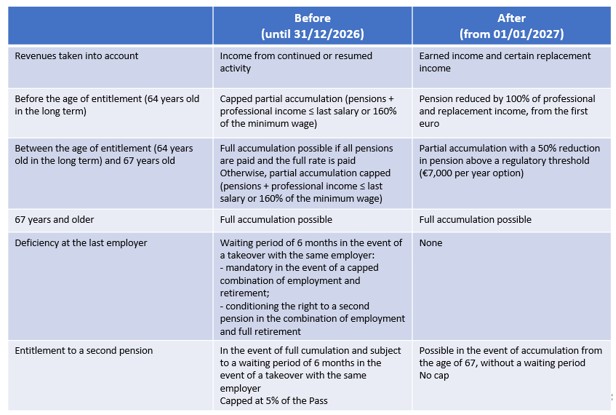
The new rules apply to insured persons who are entitled to their first retirement pension on or after 1 January 2027.
- Insured persons who are under the retirement age (64 years old in the long term): Retirement pension capping up to 100% of income in the event of resumption of activity, starting from the first euro.
- Between the legal retirement age and 67 years old: Partial accumulation with a pension cap of 50% of the income from employment above a threshold set by decree (threshold of 7000 euros mentioned).
- From the age of 67 and over: Full accumulation possible allowing the right to a second retirement pension. This second pension is now uncapped.
From now on, the income taken into account for the combination of employment and retirement is professional income and replacement income (IJSS, additional allowances paid by the employer, unemployment benefit and other benefits or allowances intended to compensate for a loss of income).
Summary table before/after the reform:
2.4 Suspension of the pension reform
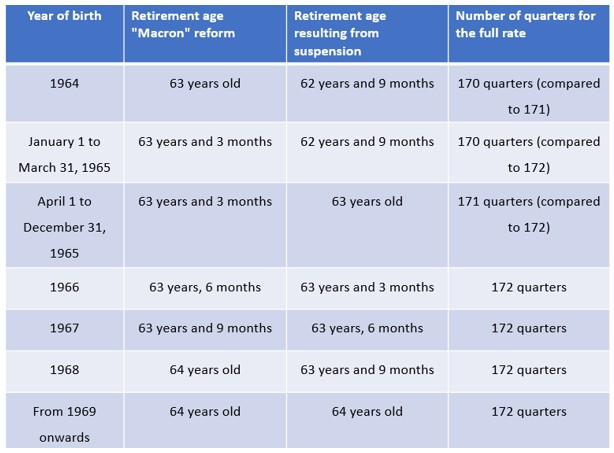
Since 1 September 2023, the age of entitlement to pension, previously set at 62, has been gradually increased, at a rate of 3 months per generation for insured persons born after 1 September 1961, in principle until it reaches 64 years of age for insured persons born on or after 1 January 1968.
The suspension of the application of this age measure until 1 January 2028 has the effect of shifting the 64-year-old threshold to the generations born from 1969 onwards, instead of 1968 as provided for in the 2023 reform.
Summary table of the suspension of the pension reform:
2.5 Measures to promote women’s pensions
Until now, increases in the length of insurance for children were not taken into account for the entitlement to early retirement for a long career.
These additional quarters (maternity, child-rearing, parental leave) will now be treated as contribution periods for this purpose, subject to a limit expected to be set at two quarters.
In addition, the law modifies the average annual salary, which is calculated as follows:
- 23 best years for women with two or more children;
- 24 best years for women with one child.
These measures apply to pensions effective from 1 September 2026.
2.6 Apprenticeship incentives
As a reminder, two aids coexist for the hiring of an apprentice, which are the one-off aid and the exceptional aid. This aid cannot be combined with each other.
The one-off aid is maintained on 1 January 2026 because it corresponds to the common law scheme provided for by the Labour Code. It is mainly aimed at companies with fewer than 250 employees recruiting an apprentice p reparing for a diploma or a professional title up to baccalaureate level (level 4). This aid is paid for the first year of the apprenticeship contract. Its amount can reach €5,000, or €6,000 when the apprentice is recognised as having a disability.
The exceptional aid for the hiring of an apprentice ended on 31 December 2025, then was renewed by decree (Decree No. 2026-168 of 6 March 2026) for contracts concluded from 8 March 2026 to 31 December 2026. Please note that contracts signed between 1 January 2026 and 7 March 2026 are not eligible for this aid.
The amounts of the exceptional aid vary according to the size of the company and the level of training:
Companies < 250 employees:
- €5,000: CAP to baccalaureate level
- €4,500 : Bac +2 level diploma
- €2,000 : diploma level bac +3 to bac +5
Companies ≥ 250 employees:
- €2,000 : CAP to baccalaureate level
- €1,500 : baccalaureate +2 level
- 750 € : bac +3 to bac +5 level
€6,000 maximum if the apprentice is recognised as a disabled worker, regardless of the size of the company.
2.7 Undeclared work: Increase in penalities
At the end of an inspection that reveals concealed work, the amount of contributions is now increased by 35% (compared to 25% previously).
In the case of aggravated concealed work (concealed employment of a minor subject to compulsory schooling, a vulnerable or dependent person, offence committed by an organised gang): increase rate of 50% (compared to 40% previously).
These new increases are applicable to procedures initiated from 1 June 2026.
2.8 Limitation of the duration of sick leave prescrptions
The law sets a maximum duration for sick leave of 1 month for the first sick leave and 2 months for a renewal.
This measure will come into force on 1 September 2026.
2.9 New birth leave
Additional birth leave is created for children born or adopted from 1 January 2026. As well as those, in the event of premature birth, whose birth was supposed to take place on or after January 1, 2026. This leave is available from 1 July 2026.
This additional leave is in addition to maternity, paternity, childcare or adoption leave.
This leave is for a maximum of 2 months, which can be divided into 2 periods of one month each, compensated by social security. Each parent will be able to take this leave simultaneously or alternately with the child for a couple.
The compensation will be degressive: a first month compensated at 70% of the previous net salary and a second month compensated at 60% of the previous net salary, within the limit of the social security ceiling
2.10 Single degressive general reduction
Since 1 January 2026, the general reduction in employer contributions (formerly the Fillon / RGCP reduction) has been reconfigured and becomes the Single General Degressive Reduction (RGDU in French).
This reform is accompanied by the abolition of the reduced rates of health contributions and family allowances, which are now integrated into this new mechanism (except for specific non-cumulative schemes: LODEOM, ZFRR, home jobs, etc.).
Main developments:
- Scope extended to 3 times the minimum wage (previously 1.6 times the minimum wage)
- More gradual degressivity in order to limit threshold effects during salary increases
Residual exemption of about 2% up to 3 times the minimum wage, then zero reduction beyond that.
2.11 Reform of the business start-up ememption (ex-ACRE)
The LFSS 2026 reforms the exemption from social security contributions granted to business creators or buyers (ex-ACRE), with an entry into force on 1 January 2026.
- Refocusing of beneficiaries
The system is now refocused on the most vulnerable groups. The following are concerned:
- young people aged 18 to 26;
- jobseekers, whether they have been receiving benefits or registered for at least six months;
- beneficiaries of the RSA or ASS;
- people with disabilities under 30 years of age;
- business creators located in priority neighbourhoods of the urban policy (QPV) or in France ruralités revitalisation zones (ZFRR).
- New procedure
The application for exemption becomes mandatory for all beneficiaries. It must be done with the URSSAF or the CGSS.
- Reduction in the level of exemption
The level of exemption is now significantly reduced and modulated according to earned income:
- when the income is less than 75% of the PASS (i.e. €36,045 in 2026), the exemption is capped at 25%;
- when the income is between 75% and 100% of the PASS (i.e. between €36,045 and €48,060 in 2026), the exemption becomes degressive;
- beyond 100% of the PASS, no exemption is applicable.
By way of derogation, heads of agricultural holdings or businesses continue to benefit from the previous arrangements.
2.12 Extension of overtime contribution reduction
The LFSS 2026 extends the flat-rate deduction of employer contributions on overtime to companies with 250 or more employees, for periods of employment from 1 January 2026.
Until now, this scheme was reserved for employers with fewer than 250 employees.
Companies with less than 20 employees (already applicable before LFSS)
- €1.50 per additional hour
- €10.50 per day beyond 218 days
Companies with 20 to less than 250 employees (already applicable before LFSS)
- €0.50 per additional hour
- €3.50 per day for employees on a fixed day package beyond 218 days/year
Companies ≥ 250 employees
- Same amounts: €0.50 / hour and €3.50 / day
This note contains summarized information. Please contact us for advice tailored to your situation. We cannot be held responsible for any misinterpretation of this sheet.
Contact
Claire APPELGHEM
HR Director/Head of Employment Law
Claire.appelghem@groupe-aplitec.com
01 40 40 38 38
Jade GENAY
Employment Law Expert
Jade.genay@groupe-aplitec.com
01 40 40 38 38