
Preamble
On the occasion of her pregnancy, the mother is entitled to maternity leave, including prenatal leave (before the birth) and postnatal leave (after the birth).
The duration of maternity leave and the amount of daily Social Security benefits paid during maternity leave may vary depending on the situation.
The employment law department takes stock of the employee’s rights and the consequences of maternity leave.
1.A legal obligation
Maternity leave is compulsory, and it is strictly forbidden to waive it.
The employer can be fined up to 1,500 euros and ordered to pay damages if he or she does not comply with this prohibition on employment during maternity leave.
Before going on maternity leave, the employee must have officially notified her employer of the reason for her absence and the date on which she is supposed to return to work, by registered letter with acknowledgement of receipt or delivered against receipt. The declaration of pregnancy is accompanied by a medical certificate drawn up by the doctor or midwife who follows the employee and attests to the expected date of delivery.
The duration of maternity leave is treated as a period of actual working time for the purpose of determining seniority rights and calculating the duration of paid leave.
Maternity leave is also assimilated to a period of presence for the distribution of profit-sharing.
NB : As a reminder, an additional birth leave entitlement has been introduced for children born or adopted on or after January 1, 2026. This leave is in addition to maternity leave, paternity and childcare leave, and adoption leave.
The leave may be taken in two separate periods of one month each. Both parents may take this leave either simultaneously or alternately to care for the child. This new leave entitlement will come into effect on July 1, 2026.
2. The duration of maternity leave
The legal duration of maternity leave varies according to the number of children living in the household and the number of children to be born:
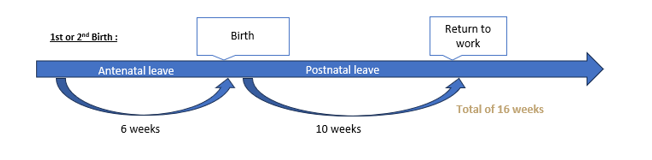
- If the employee is expecting only one child, the duration of her maternity leave will depend on the number of children already in her care. For example, for a first or second birth, the total duration of maternity leave will in principle be 16 weeks:
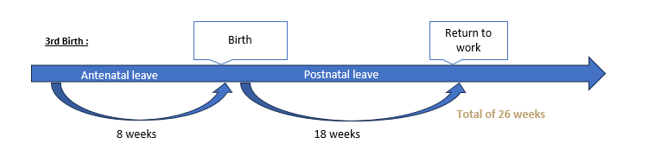
- On the other hand, if the employee is expecting her 3rd or more child, the maternity leave will in principle be 26 weeks:
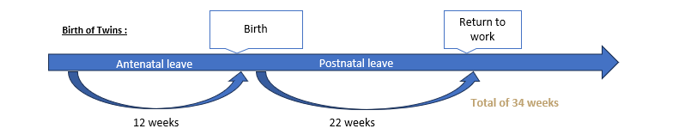
- If the employee is expecting twins, the employee will benefit from 34 weeks of maternity leave, in principle:
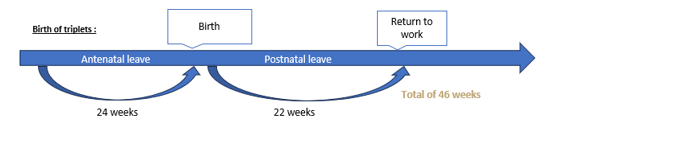
- Finally, if the employee is expecting triplets, she will benefit from 46 weeks of maternity leave, in principle:
NB: contractual provisions may provide for longer periods of leave.
The employee can also waive part of her leave; however, she must stop working for at least 8 weeks, including 6 weeks after giving birth.
The employee may choose to shorten the start of her prenatal maternity leave, within the limits set by law: a maximum of 3 weeks of reduction.
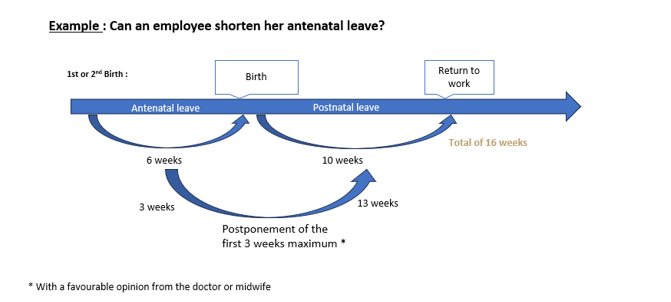
In addition, there are specificities, in particular due to late or early delivery:
- If the birth arrives late, the prenatal leave is extended until the actual date of delivery, without reducing the postnatal leave.
- Similarly, when the employee gives birth prematurely on leave, the total duration of the maternity leave remains the same. In practical terms, the antenatal leave period is shortened, and the postnatal leave period is extended by the same amount.
Specific provisions also exist in the event of hospitalization of the child at birth or in the event of the death of the child at birth. Finally, in the event of a pathological pregnancy, the duration of maternity leave is increased by a maximum of 2 weeks before the expected date of delivery or 4 weeks after delivery.
3. The remuneration of the employee on maternity leave
Legally, there is no obligation on the employer to maintain the remuneration of an employee on maternity leave, as the employment contract is suspended.
Compensation is the responsibility of Social Security. However, contractual provisions, custom or a collective agreement may provide for the employer to continue to pay the salary.
The daily social security allowance (IJSS) guarantees the employee her full salary up to the monthly social security ceiling (PMSS). However, the employee must be able to prove that she has been affiliated to the Social Security system for a minimum period of time and that she has a sufficient previous condition of employment or contributions.
4. Protection against dismissal
An employee on maternity leave is protected against dismissal:
- This protection is said to be absolute during the legal duration of maternity leave and its possible extension for a medical condition. Thus, a dismissal, even if based on serious or gross misconduct or the impossibility of maintaining the contract, would be considered null and void.
- This absolute protection also applies during paid leave taken immediately after the end of the employee’s maternity leave.
This protection is said to relate to the employee’s return after the end of her maternity leave and paid leave taken immediately after the end of maternity leave. Thus, the employer cannot dismiss the employee during the 10 weeks following the maternity leave or the paid leave taken immediately after it. However, dismissal is possible in the event of serious misconduct or if the employer is unable to maintain the contract for a reason unrelated to maternity.
However, the employee may resign during her pregnancy without notice.
5. Return from maternity leave
Maternity leave entails the simple suspension of the employment contract and not its termination, which in no way alters the employee’s rights in the company. At the end of the maternity leave, the employee must return to her previous job or a similar job with at least equivalent pay.
An employer who fails to offer a similar job may have to pay damages for unfair performance of the employment contract.
The employee who returns to work must also be offered a professional career path interview devoted to her professional development prospects (particularly in terms of qualifications and employment).
The employee must have a return to work visit with the occupational health practitioner no later than 8 days after returning to work.
The return to work visit takes place during working hours. If the resumption visit cannot take place during working hours, the time required for medical examinations is paid as actual working time.
***
This sheet contains summarized information. Please contact us for advice tailored to your situation. We cannot be held responsible for any misinterpretation.
Contact
Claire APPELGHEM
HR Director/Head of Employment Law
claire.appelghem@groupe-aplitec.com
01 40 40 38 38