
Preamble
The second part of the e-invoicing reform concerns the obligation to transmit transactions data that do not fall within the scope of e-invoicing to the tax authorities.
The transmission of this information is intended to allow the pre-filling of tax returns. This system is called “e-reporting“.
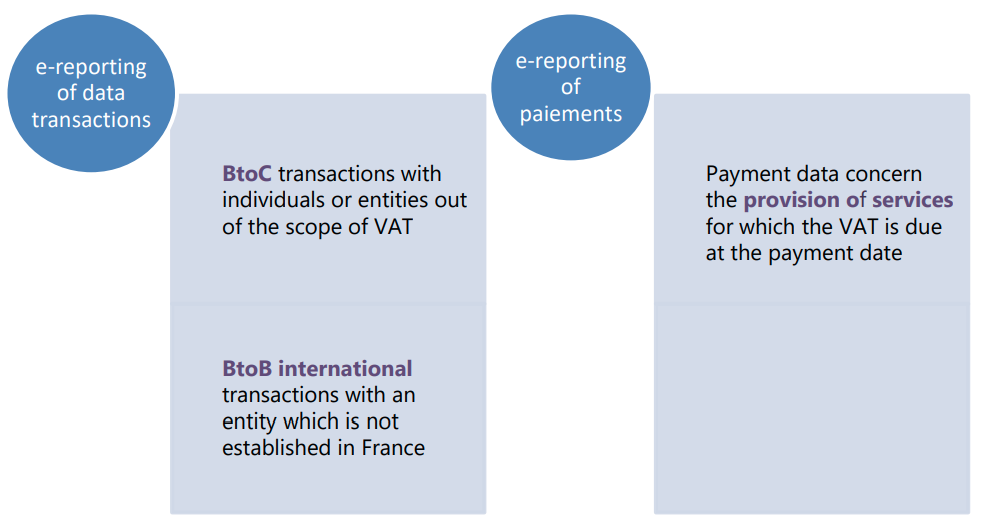
E-reporting is structured into 2 main types of information:
📆 Calendar (reminder)
The transmission of transaction and payment data is mandatory:
👉 Effective September 1, 2026 for large and mid-sized businesses[1]
👉Effective September 1, 2027 for small and medium-sized businesses.
🎯 What are e-reporting requirements ?
[1] Based on the most recent financial statements closed on 1 January 2025, the thresholds triggering an issuance obligation on 1 September 2026 are +250 employees and turnover > €50 million or balance sheet total > €43 million at the entity level
I. WHO IS SUBJECT TO E-REPORTING
All companies subject to VAT established in France are concerned by the e-reporting of transaction data, when they carry out operations with:
- individual or non-taxable customers (BtoC)
- foreign companies (international BtoB)
- as a seller or service provider: exports, intra-Community deliveries, distance sales, provision of services to taxable entities in the EU or outside the EU, etc.
- as a buyer or recipient of services: intra-community acquisitions of goods, self-liquidated services in France
- companies located in Monaco
- by foreign companies not established in France as long as the transaction they carry out is taxable in France.
As with the e-invoicing obligation, transactions falling under Articles 261 to 261 E of the French Tax Code (medical activities, education, bare residential rentals, certain banking and financial transactions, games of chance), are excluded, as well as transactions classified as classified.
Imports (acquisition of goods from a non-EU state) are also excluded from the system, as the data are already collected via pro-customs.
II. HOW DO I TRANSMIT INVOICE DATA TO THE TAX AUTHORITIES?
Approved dematerialization platforms (AP) will transmit information relating to e-reporting via the Public Invoicing Portal (PPF in French), which acts as a data concentrator, as part of a global system of interconnection between platforms known as the “Y-diagram”.
The PPF will transmit the data collected in this way to the tax authorities.

III. DATA TO BE TRANSMITTED
A. BtoC transactions
In the case of BtoC sales (sales to individuals or to a non-taxable legal entity), there are 10 e-reporting data. They relate to the information allowing the administration to obtain the tax bases broken down by VAT rate and the amounts of VAT per day.
The data transmitted is consolidated data per day over the reporting period concerned. No personal data (customer name, address, etc.) is transmitted.
This data comes from the cash register system (called in France daily “Z tickets”).
Manual entry via the PPF is possible, but in this case, you must re-enter the details of the daily flows!
B. International BtoB transactions
In the case of international BtoB sales, the data to be transmitted to the tax authorities is the same as that transmitted in the context of e-invoicing, i.e. the information defined by the CGI and the Commercial Code allowing the pre-filling of VAT returns.
The SIREN number will be replaced by the intra-community VAT number for operators located in the EU or by a foreign number (country code +16 first characters of the company name) for other non-EU operators.
C. E-reporting for the data of payments
The payment data to be transmitted relates only to transactions relating to the provision of services, unless an option is made for the payment of VAT on the invoice called “option TVA sur les debits”.
This obligation concerns:
- Services that have given rise to an electronic invoice between professionals in France (except for the option for the payment of VAT on debits).
- International supply of services (except those giving rise to reverse charge).
- The provision of services for the benefit of non-taxable entities.
The payment data is transmitted by the provider.
They concern the date of collection of the payment, the break-up per VAT rate and, for transactions giving rise to an invoice, the invoice number.
This data must be transmitted on the date of receipt of the payment of the transaction, regardless of the payment methods chosen.
IV. HOW OFTEN IS THE DATA TRANSMITTED
The frequency of transmission of transaction and payment e-reporting data depends on the tax regime of the taxable person declaring:
A. Transaction data reporting
The transmission of transaction data is carried out per decade (every ten days) for operators who are subject to the monthly normal VAT regime.
The periodicity is monthly for entities under a quarterly normal regime and half-yearly for entities with a simplified regime.
For small entrepreneurs benefiting from VAT exemption under article 293 B of the CGI, the transmission will be carried out every 2 months.
B. Payment data reporting
Payment data is transmitted monthly, before the 10th of the following month.
V. ARE THERE ANY SANCTIONS ?
Companies that do not comply with the obligation to transmit e-reporting data are liable to a fine of €250 per transmission not made within the limit of €15,000 per year (art.1788D – I of the CGI).
VI. DEPLOYMENT OF AN INTEGRATED OFFER BY OUR THE FIRM
Before choosing a solution or internal reorganization,
let’s talk about it together!
Our firm invests in a complete and compatible solution, backed by an Approved Platform (AP), to facilitate your compliance:
- Receiving, reading and paying your supplier invoices
- Issuance of your customer invoices in regulatory electronic format (E-invoicing)
- E-reporting
🛠️ We help you :
- Map your invoicing flows to identify your reporting obligations,
- Define the optimal organisation,
- Implement a fluid and secure solution thanks to the tools offered by the firm.
👉 Webinars followed by personalized appointments will be offered during the 4th quarter of 2025 to present the chosen solution.
You will receive our next information note in 10 days, which will present the different tools and platforms involved in the reform.
Anticipate this evolution by contacting your usual contact.